

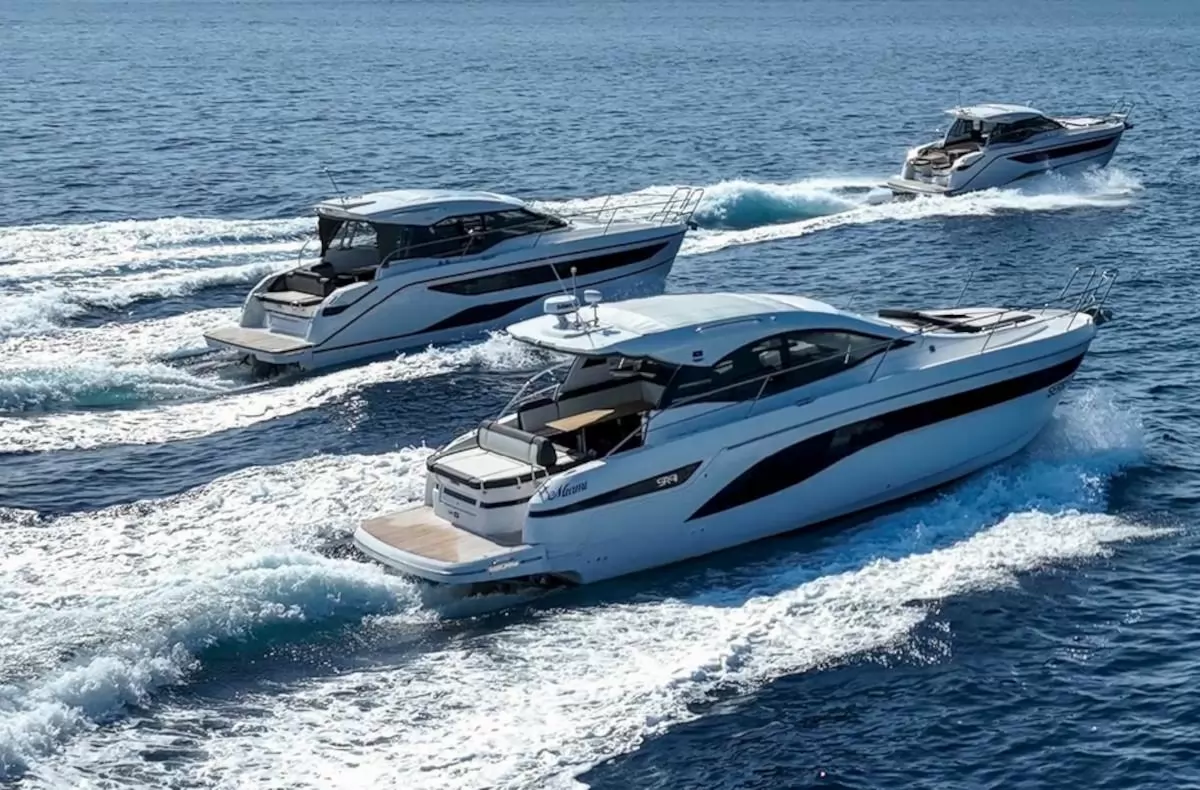
Motorboats (often called powerboats) are the true masters of speed and convenience on the water. Unlike sailboats, they don't wait for the wind; they rely on powerful engines to get you wherever you're headed. From small and nimble runabouts to majestic megayachts, the world of powerboats is vast and diverse.
Before stepping on board, it’s helpful to learn the 'language' of captains: the bow is the front, the stern is the back, the hull is the bottom, and everything above it is referred to as the topsides.
Why Hull Shape Matters
The design of the hull determines how the boat handles rough seas and how much fuel it consumes. There are three main categories:
Displacement Hull: These boats literally 'push' the water aside. They are slow but exceptionally fuel-efficient and stable. You’ll typically see this design in large trawlers and tugs.
Semi-Displacement Hull: Designed to partially rise out of the water at higher speeds. It’s a compromise between efficiency and speed—commonly found on larger motor yachts.
Planing Hull: These boats are built for speed. Upon acceleration, they 'lift' off the water and skim across the surface. Most sport and fishing boats use this type.
Specialized Shapes for Specific Needs
Catamaran: Two separate hulls connected by a deck. It provides incredible stability and vast deck space.
Deep-Vee: The king of rough water. It cuts through waves smoothly without excessive jarring or 'slamming.'
Pontoon Boat: A deck mounted on aluminum tubes. It’s like a 'floating patio'—super stable, but best suited for calm waters.
Flat Bottom Hulls (Jon boats): Perfect for shallow, quiet waters, but be careful—in rough seas, you’ll feel every single wave.
What Are Boats Made Of?
Most modern boats are constructed from fiberglass (FRP) due to its strength and ease of maintenance. The process begins with a glossy resin layer called gelcoat, which gives the boat its shine. To make them even lighter and stronger, builders often use vacuum-bagging or cored hulls with a center made of foam or balsa wood. Smaller fishing boats are often made of aluminum.
The Heart of the Boat: Propulsion Systems
How does the engine's power reach the water? There are five primary ways:
Straight Inboard: The engine is inside the boat, and the propeller is outside on a fixed shaft. Steering is handled by a rudder.
Sterndrive (Inboard/Outboard): The engine is inside, but the drive unit (containing the propeller) is mounted externally on the transom and pivots to steer.
Pod Drive: A modern system where drive units under the boat rotate independently, offering unsurpassed control during maneuvering.
Jet Drive: Forces a high-pressure stream of water through a nozzle. Ideal for personal watercraft (PWCs) and boats operating in very shallow water.
Outboard Motor: The entire engine, transmission, and propeller are in one self-contained unit mounted on the transom. It’s the easiest type to maintain or replace.
Which Boat Is Right for You?
Bass Boat: For fishing enthusiasts in calm lakes and rivers.
Center Console: Ideal for fishing, as the layout allows 360-degree accessibility around the entire boat.
Express Boat: Sleek, with a small cabin for overnight stays—perfect for a weekend getaway.
Trawler: For those who want to travel long distances slowly and comfortably.
Mega Yacht: The pinnacle of luxury, usually 30 meters or more in length.
Choosing a boat depends on where you plan to cruise and how fast you want to get there. We hope this guide helps you find your ideal partner on the water!

