

Ето превода на статията на английски език, във формат удобен за копиране. Използвал съм прецизна морска терминология, за да бъде текстът полезен и професионален за международна аудитория.
You might have a 500-horsepower engine, a designer galley, or a dozen luxury cabins, but absolutely nothing will influence your boating pleasure as much as the hull design.
For many buyers used to cars, this comes as a surprise. With cars, shape mainly affects aesthetics and aerodynamics, but with boats, it determines how the vessel behaves in the inhospitable water environment. You wouldn't take a Rolls-Royce off-roading, would you? In the same way, your choice of hull should be dictated by your plans, not just by color or price.
The Great Truth: There Is No Perfect Hull
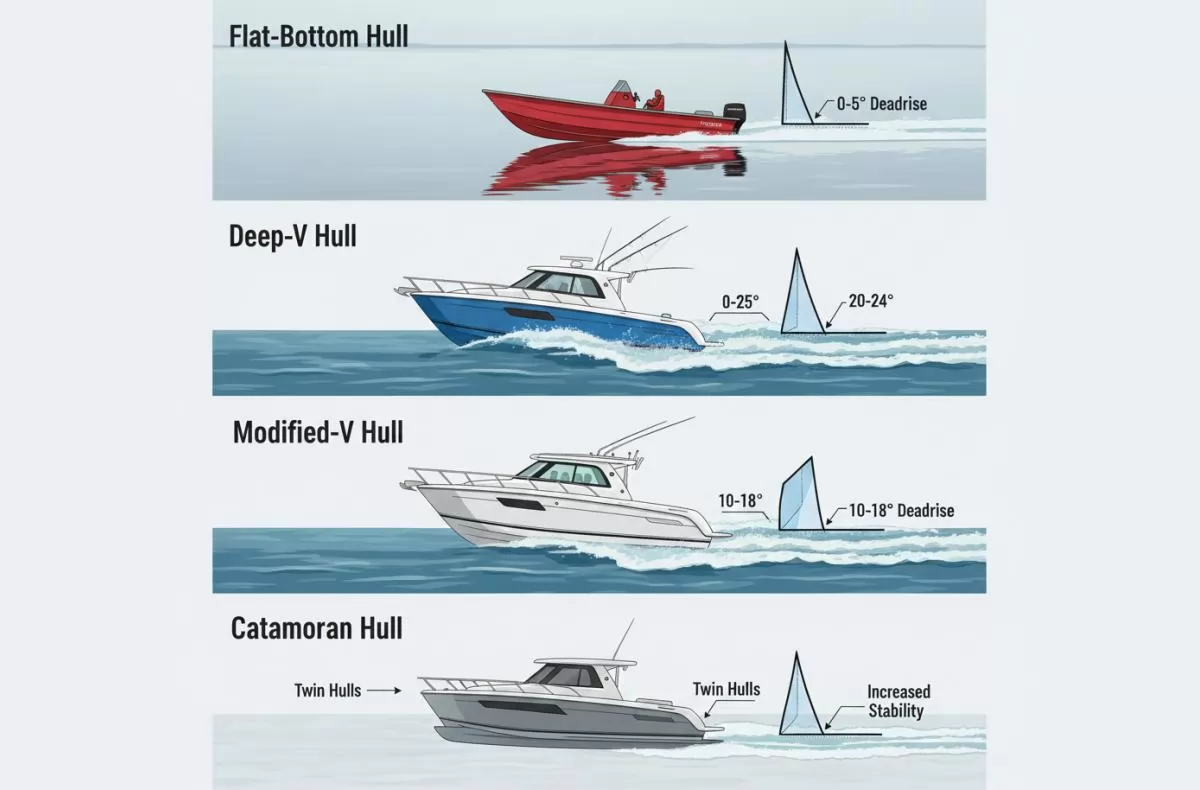
Every design is a compromise. In some cases, you sacrifice stability for speed; in others, weight for strength. Before you choose, you must understand one key term: deadrise. This is the angle that the boat's bottom makes with the horizontal. The larger this angle, the sharper the 'V' of the boat.
1. Flat-Bottom Hulls: Kings of Calm Waters
Excluding ordinary rowing boats, pure flat-bottom hulls are rare, but the term is used for boats with minimal deadrise (a few degrees).
Strengths: Maximum stability and the ability to literally 'fly' (plane) over smooth surfaces. They are ideal for water skiing because they create a smooth wake.
Weaknesses: Even in light chop, such a boat will 'rattle your teeth.' It slams into the surface instead of cutting through it.
2. Deep-V Hulls: Masters of the Open Ocean
This is the opposite of the flat bottom—a sharp wedge from bow to stern.
Strengths: It cuts through waves cleanly and provides a smooth ride even in rough weather. This is the standard for offshore fishing boats.
Weaknesses: These boats draw more water (deeper draft), require more power (due to higher drag), and are prone to rolling when at rest or moving slowly.
3. Modified-V Hull: The All-Rounder
This is the most popular choice for small and medium-sized powerboats. It combines a sharp 'V' at the front (to slice through waves) with a flatter rear section (for stability and speed).
Why choose it? Because it is the golden mean. It is ideal for families who want to water ski on a lake one weekend and fish in the sea the next.
4. Catamarans: Stability Squared
Catamarans use two narrow hulls connected by a common deck.
Advantages: Exceptional stability, low drag, and shallower draft. They often require smaller engines than monohulls of the same size.
Disadvantages: Less internal space for cabins and a unique appearance that doesn't appeal to everyone.
The Secret in the Details: Strakes and Chines
Have you noticed the longitudinal strips along the bottom of modern boats? These are the strakes. They help the boat get on plane faster, act as shock absorbers when hitting a wave, and deflect spray outward to keep you dry in the cockpit.
The chine is the point where the hull bottom turns up to become the side of the boat. Modern designers add a 'chine flat,' which increases lift and stability, reducing rolling while trolling or drifting.
Which Hull Is for You?
For speed and lakes: Flat bottom.
For offshore fishing: Deep-V or Catamaran.
For water sports: Modified-V.
For a bit of everything: Modified-V – it’s your Swiss Army knife on the water.
Choosing the right hull shape is an investment in your crew's comfort. Before finalizing your purchase, think carefully not about where you want to be, but where you will actually sail most often.

